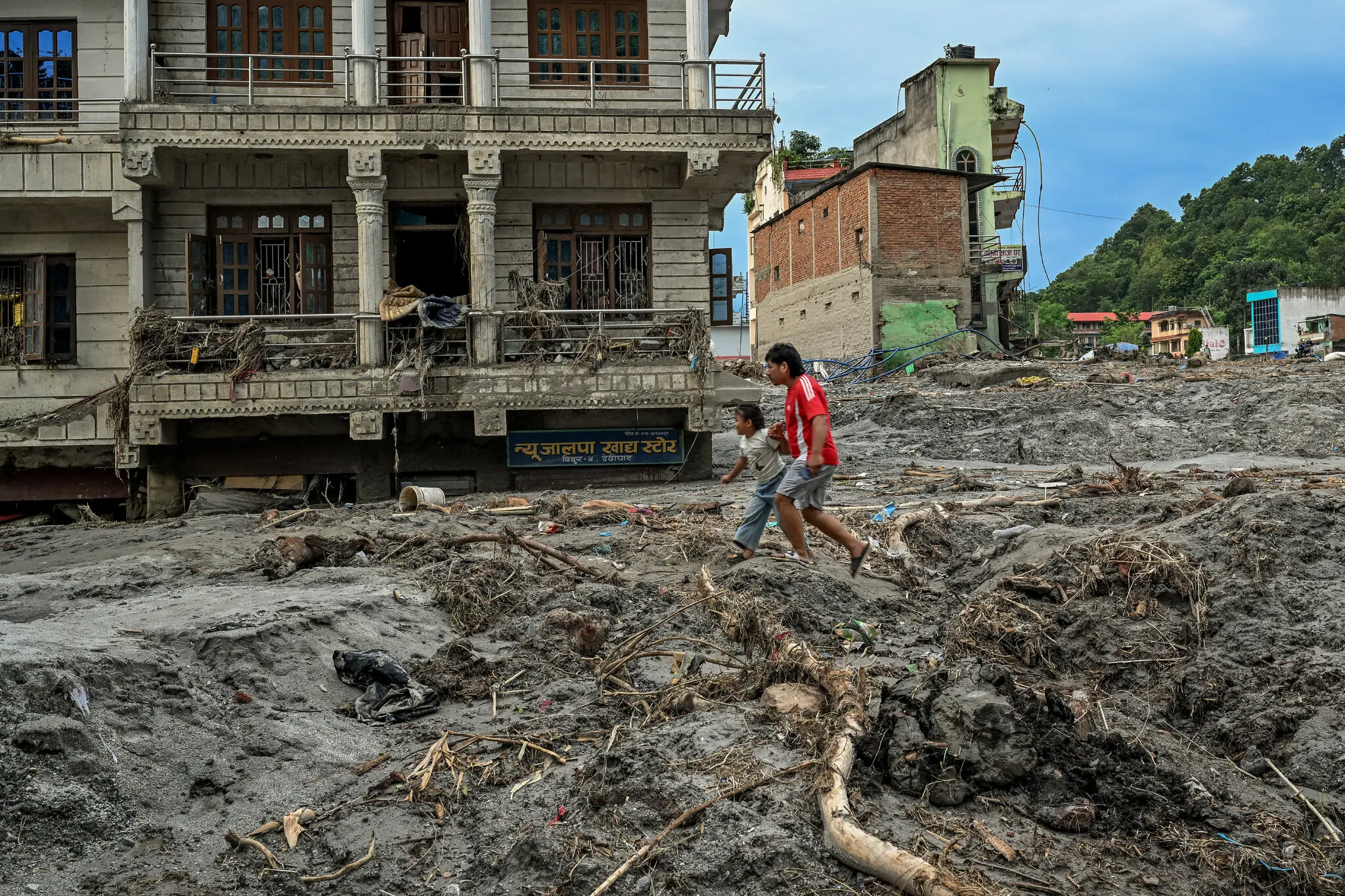
The authorities in Nepal and Tibet said that nearly 4,500 people were missing a week after a deadly Himalayan landslide and glacial collapse.
From The New York Times: https://www.nytimes.com/2026/08/26/world/asia/nepal-tibet-floods-wtk.html?smid=whatsapp-nytimes
The death toll from the catastrophic Himalayan floods passed 1,100 people on Wednesday, according to the latest tally from the authorities in Nepal.
More than 3,900 people were unaccounted for in Nepal, including several hundred foreigners, the country’s disaster agency said. In Gyirong County, in Tibet, 546 people remained missing, Chinese state media reported.
The disaster, most likely set off by a landslide and a glacier collapse, has killed at least 1,114 people in Nepal and 16 in Tibet, according to the authorities, as floods washed away roads, bridges and entire villages. Rescue crews have been searching a sprawling area on both sides of the Nepal-China border as hopes dimmed of finding more survivors.
Here’s what to know.
Where did the floods hit?
Torrents of water and mud rushed last week through the valley of the Trishuli River, which is flanked by steep mountains and straddles the border between Tibet and the Rasuwa district of Nepal.
Images from the disaster captured the terrifying speed and force of the floods. Surveillance footage verified by The New York Times shows crowds running from the surging water before it engulfs buildings and vehicles at the Gyirong crossing at China’s border with Nepal.
The Chinese state news agency Xinhua reported “significant” casualties at Gyirong. Other footage released by Chinese state media showed surging waters and mud overwhelming buildings, uprooting trees and blocking roads.
Video and images from Nepal show the debris-choked river wiping out bridges, and towns partially buried in mud. Tens of miles of roads and more than 40 bridges were destroyed, and several hydropower projects sustained heavy damage, according to Nepali officials.
How can a flash flood happen without heavy rain?
Scientists who analyzed satellite imagery and seismic data said that a high-altitude landslide coinciding with a glacial collapse most likely set off the flooding. Images showed that a huge section of bedrock beneath a glacier on the north face of Langtang Lirung, a mountain in Nepal near the Tibetan border, had given way at an elevation of about 17,000 feet.
“The rock that the glacier was sitting on collapsed,” said Kristen Cook, a geomorphologist at the Université Grenoble Alpes in France. The combined collapse sent millions of metric tons of rock and ice into the valley below.
The event was so powerful that the U.S. Geological Survey registered it as a magnitude-5.2 seismic event.
As the rock and ice surged down the mountainside, the flow incorporated water and river sediment, becoming a torrent that traveled dozens of miles through a network of rivers and tributaries.
Who are the missing people?
Nepal’s disaster management authority said that missing foreigners included travelers from Australia, Britain, Malaysia and the United States. Also among them were about 100 Chinese citizens, according to the Chinese Foreign Ministry.
In Tibet, about 260 foreigners were among the missing, Chinese state media reported. They included 104 Nepalis, 49 Indians, 33 Latvians and 18 Americans.
About 300 Indians were missing in Nepal, India’s foreign ministry said, including many pilgrims traveling in groups to or from Mount Kailash in Tibet. Mount Kailash is a sacred site for multiple faiths, including Hinduism.
How common are landslides in the region?
Despite lower-than-average rainfall across Nepal this monsoon season, the local news media reported heavy rains that caused deadly landslides and flash floods earlier this month.
In 2024, floods and landslides killed hundreds in Nepal, including in the densely populated region around Kathmandu, the capital.
Nepal is prone to landslides and floods when heavy monsoons collide with the Himalayas.
The warming climate has made weather events more dangerous and deadly, causing frequent flooding from melting glaciers. Climate change has also intensified rainfall. At the same time, rapid development and haphazard construction have added to the risk that lives will be lost in natural disasters.
Reporting was contributed by Binod Ghimire, Lily Kuo, Mujib Mashal, Suhasini Raj, Hari Kumar, Leo Sands and Pranav Baskar.
Zane Irwin is an international reporter and a member of the 2026-27 Times Fellowship, a program for journalists early in their careers.
Lynsey Chutel is a Times reporter based in London who covers breaking news in Africa, the Middle East and Europe.